Never stop writing

Church Feast
Blog post description.
STORIES
About the St. Mary’s Church feast in Nayakakanda, from the hoisting of the kodi gaha and community celebrations to the colourful rituals, markets, food, friendships, and chaos that made it the most festive event of the year.
2/1/20112 min read
1 February 2011
When I was thinking about my growing-up years in Nayakakanda in Hendala, I was reminded that St. Mary's Church feast at Nayakakanda falls in this month. I do not remember exactly which Sunday is the church feast, but the church feast was the most festive event of the year.
The feast would begin weeks before by hoisting flag trees in front of the church as well as at the Nayakakanda junction. Hoisting the flagstaff, or the kodi gaha (flag tree), was an exciting affair. It is done on a Friday a few weeks before the feast. The flag tree is a huge and long wooden pole, sometimes with the bottom of it as big as a wooden electric/telecommunication pole but as tall as about 20 to 30 meters. On top of it is a cross often lit with electric bulbs. The flag tree at St. Mary's Nayakakanda was painted in light blue and white paint. There are ropes attached to different levels of the flagstaff, and colorful flags are affixed to the ropes. People would gather and use thick and strong ropes and ladders to hoist the flagstaff. Once the flagstaff is erected, it is stabilized by strong ropes pulling in different directions, and the ropes are tied to permanent structures or trees. Then ropes with flags, one end tied to the pole, are tied around the flagstaff in different directions. Then, using lines of electric bulbs, the tree is lit. Once the tree is erected and made stable, people would all clap and celebrate this very physical affair. As soon as it is erected, kiri bath (rice cooked in coconut milk, pressed together and cut into pieces of cake) and banis (bread buns) are distributed free of charge by some parishioners. The young ones would compete to get kiri bath and banis as if they had been starving for days. But it was the thrill of making the whole affair chaotic. At the end, there would be kiri bath everywhere, and a big mess would be left behind. What I liked about this was the whole community aspect of conducting this affair. Someone who had conducted this affair for many years would naturally take the leadership and supervise others to hoist the flagstaff. The parish priest is there to witness the event, but his role is merely that of an observer. It was the lay parishioners who managed the whole affair. It was also the lower-middle-class people, laborers, fishmongers, and carpenters who generally led this event, not white-collar parishioners. So, it was the common man's event to begin the festivities. This kodi gaha would be there for two or so weeks during the church festivities of the feast.
Decorating the church
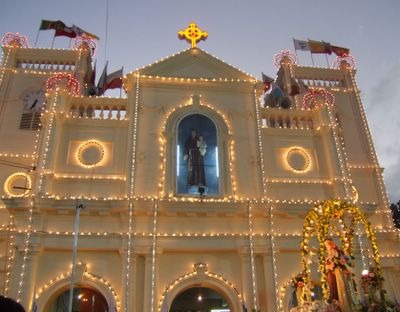
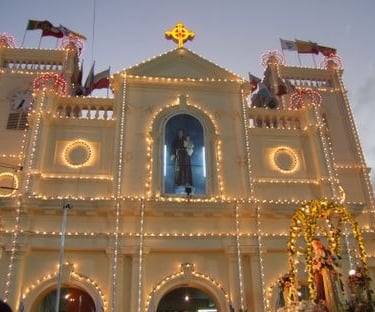
The church too would be lit up with lines of electric bulbs.
(to be completed)
Going to Novena
...
Walan Market
...
Miniature clay pots and chinchoru bath
...
Carnival with merry-go-round
...
Colourful plastic bangles (walalu) and accessory stalls
...
Aluwa and bibikkam
...
Achchaaru and other snacks
...
Hanging out at night with friends
...
Inviting relatives home for a meal
...
Getting drunk and bloody fights
...