Never stop writing

Elections and the Servant of Compassion
About 8 January 2015 Presidential Election in Sri Lanka. On the hindsight, rather naiive reflection
REFLECTIONS
Sanjeewa Liyanage
1/9/20155 min read
9th January 2015
In Sri Lanka the 7th Presidential Election has been concluded. A friend of mine from Europe was visiting Sri Lanka right before the election. And I was very worried for her safety, as I knew and witnessed election-related violence first hand in my own country. Surprisingly, this was one of the most peaceful elections, at least on the day of the election. I was very happy and relieved. The last thing a visitor to my beloved country should see is violence and people at their worst. But the cycle of violence also has its end. I think we have reached that end. I know for sure, that this is THE beginning of a new political era. A few months ago I have lost complete faith in the politics in my country. But within two months or so, the situation changed drastically. We are more hopeful than ever. Its not just wishful thinking anymore. After a long time, I begin to have faith in the electoral process and the present leadership that is to spearhead change.
My first memory of election is the 1977 General Elections in Sri Lanka. I was 10 then but had a tremendous interest in that election. My family, coming from a Catholic/Colombo background, were generational supporters of the United National Party (UNP). And during that election UNP ousted the other predominant political party, Sri Lanka Freedom Party (SLFP) with an unprecedented majority: 5/6th. There was no TV in Sri Lanka then. There was radio and newspapers. I remember the newspaper, Dinamina, has printed a supplement listing all 225 electorates with all candidates. We were all huddled around the bulky old radio set at my aunt’s home in Kolonnawa. As the results started coming in, I was obsessed with marking each result on the newspaper against the name of each candidate. I did this for all 225 seats over a period of about 24 hours, non stop listening to the radio. After this exercise, I could recite the whole list of 168 electorates and the winning candidates and even the number of votes some of them have obtained. This was my introduction to parliamentary politics. Andy my interest in politics never backtracked since then—I was always a watchful eye.
Sri Lanka has two mainstream political parties, SLFP and UNP. When one got elected as the government, the other was the opposition. For the first time, this balance was disturbed during the 1977 election. SLFP only obtained handful of seats, surprising everyone. It was a colossal defeat. They only won 8 seats out of 168 total electoral seats. The UNP won 140 seats. For the first time, minority Tamil party became the opposition. Tamil United Liberation Front won 18 seats. Again, for the first time, the balance of power was seriously disturbed.
I did not understand the consequence of what happened then. I was 10 and my family too was not intellectuals or politicians. We were elated by the majority UNP win. What a great feat! But this landslide election results paved the way for the UNP to introduce disastrous policies to the country, paving the way to a civil war that lasted 30 years losing hundreds of thousands of lives. J R Jayawardana and R Premedasa, two main pillars of UNP since 1977 were my heroes in 1977. My family was proud to see the arrogance of JR. So were many middle class at that time. However, his introduction of the 1978 Constitution and the Executive Presidency, centralized power and the president was made in political sense invincible. Civil war was prolonged, and dissent was crushed. Successive governments, despite their electoral promises to get rid of executive presidency and bring real democracy to the country, dragged the country into an abyss of corruption, nepotism, political vengeance and un-rule of law. In short my country has become a country of hate and than compassion. Handful of politicians bear responsibility for that. This disgusted me. This made me very sad. These politicians got elected at the expense of the votes of majority poor. But they abused power, corrupted not only themselves but the state institutions and civil service. Political thuggary became a norm. Already deteriorated police force became not law enforcers but order enforcers of politicians. State media became not only mouthpieces of the regime but began widespread mud-slinging against anyone who dissented the power holders.
The change that came about in the early hours of 9th January this year was mainly also due to the power of alternative media such as social media. The young and the intellectuals could see both sides of the political debate only through social media or the Internet. This too was unprecedented. After a long time, I see hope. I also see unity among major political factions to achieve one big objective: to right the wrongs. Unlike in 2010, when the president elect took steps to arrest his opponent and later put him in jail, this time, the winners of the election asked for calm and not to exercise any act of hate and vengeance. So it was. No one was arrested, no house was stoned and no person was assaulted. This is the Sri Lanka I want to return to, where I could see people at their best; where I could see compassion among people than hate and violence. Too much hate has been spread. It is the time to spread compassion. It is the time to let the rule of law flourish. It is the time to let the meritocracy flourish. It is the time to bring an end to corruption. It is the time to really alleviate poverty. It is the time to bring Sri Lanka to its full potential to make it s developed nation. After being away from Sri Lanka for 25+ years, I still hold the Sri Lankan nationality and passport. I want to be proud to hold this passport. I want to see a time when my passport is respected by the world like the one of Malaysia or Singapore. I like to see a vibrant political culture that respect dissent, not a violent political culture we have had during last few decades. I want a person to be able to say publicly the president ‘son of a bitch’, and not to be abducted and disappeared because he/she said that. I do not want to see politicians, prime ministers and presidents regarded and called as king or queen and his sons princes. I would like to see a poor young man from the village to have same opportunity as the son of the president. I want the public to fear thieves not the police. My wish list can go on.
The change that happened did not come only due to politicians. The civil society leaders are equally responsible for paving the way to this change, taking grave risks. My friend Sudarshana’s Nihahase Wedikaava (Stage of Freedom), work of my friends like Britto Fernando to uphold rights of the workers, the poor and the families of the disappeared (and Britto received serious death threats just a few days before the Presidential Election!), artists and journalists like Chandraguptha Thenuwara, Manjula Wediwardana, spouses of disappeared journalists like Sandya Ekneligoda, persons who were arrested and harassed like my junior student movement cadre Ruki Fernando and the others in Sri Lanka who have risked much deserve credit at this moment.
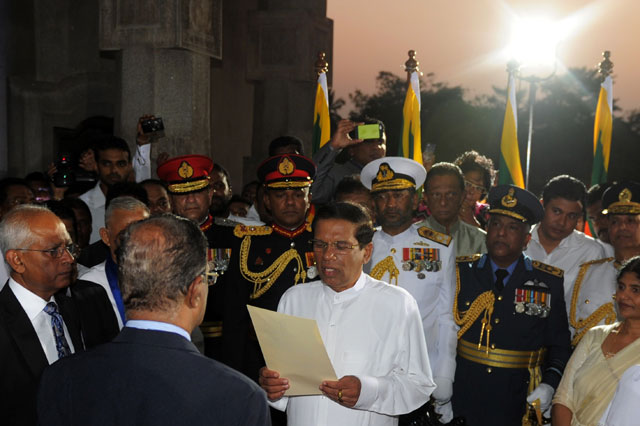
After a long time I told my kids yesterday the meaning of the word compassion in Sinhala is Maithree (my3 for easy pronunciation). Then I also told them paaler in Sinhala means, the servant. Maithree-Paaler (spelled Maithripala) is the name of our new president, meaning servant of compassion. That is exactly what we need at this moment. Not a Rajapake (meaning loyal to the king), but a servant of compassion to heal the wounds of millions and uplift them from misery.