Never stop writing

Life beyond books--My beginnings in YCS
My lifechanging experience when I joined the Young Christian Students YCS movement in 1983
STORIES
Sanjeewa Liyanage
11 min read
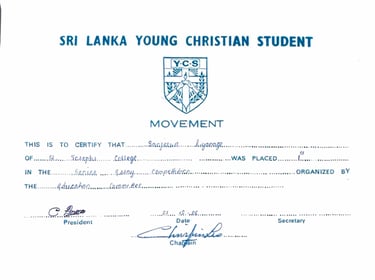
I was thinking what best way to name this blog post. It is essentially about my journey of life beyond school books. It was a fascinating discovery of self discovery. It all happened by a sort of accident. Or not an accident? A serious of events triggered by one single event that changed my whole life.
YCS and Election
After the event described above, somehow I became popular in the school. Most knew my name, at least. Until this point, I was never active in any social clubs, what we called extra-curricular activities. But after this event, I was approached by many societies/organizations in the school soliciting my membership. They just wanted me to become a member of their group. I was evasive in the beginning. I had heard about all these organizations/clubs all throughout. But I had no interest. I was happy with the way I was. In fact, the only other activity I did was to become a member of the school's Cadet Corps. There, I learned to be physically exhausted. Being a member of the Cadet Corps was possibly inspired by my father's career as a soldier. Twice a week, we had rigorous training, marching, running, and drills, and I was somehow drawn into it.
Then, at one point in 1984, someone, and I think it was Vishanth Weerakkody, dragged me to a meeting of the YCS Cell of Year 12. I sat there and was quickly assigned to be the secretary of the Year 12 YCS Cell. The secretary's role was to document the minutes of the meetings. I was possibly chosen for that position because I could write well. So I suddenly became an office bearer of a school YCS Cell, as we called it then. We had Vishanth and Mauris Gurusinghe, who were members of the YCS then. Coming from the same place, Nayakakanda and Thimbirigasyaya Road in Hendala, Maurice, Vishanth, and I spent a lot of time together, especially preparing ourselves for Advanced Level exams and going for private tuition to a well-known teacher in Hendala, Mr. Duncan Abeyratna, who lived on Weliamuna Road. We three also were in the same class, Maths Class, during A/L studies. So that was how I joined YCS.
YCS in my school was the largest unit in any school in Sri Lanka. There were YCS cells starting from Year 9 or so until Year 13. There were annual general meetings and elections within the school YCS. And I do not know how it happened, but I was nominated for the SJC YCS Secretary position at the end of 1984 and was elected. Suddenly I became an office bearer of the SJC YCS and an executive committee member of the SJC YCS Unit, and had to represent the school YCS at monthly Diocesan YCS meetings, which we called the Executive Committee of YCS Colombo Diocese. At that time, the national chaplain of the YCS was Fr. Chrispin Leo, who resided at St. Joseph's College. I did not know him at all then. I was closer to Fr. Bonnie Fernandopulle, the spiritual director, or the Animator, as we called him then, of SJC YCS. A quick bond and trust developed between Fr. Bonnie and me, which developed into a friendship that lasted until I left the country. Fr. Bonnie was an excellent mentor and a friend. During the election to become the Secretary of the YCS, one person in particular pushed my case, and either Terrence or Tyrrone (twins) nominated me. But the one person who pushed me to the top was Vishanth's cousin, Roshan Abeysundara. Soon after that, I developed a close friendship with Roshan Abeysundara, and we had a closer and deeper friendship than my friendship with Vishanth. Roshan was another mentor and an older friend who always backed me and advised me. If I am correct, Roshan was the President of YCS at that time, and we had to work often together.
Soon after my election to the Exco of the school YCS, I spent much of my time with the organization, within and outside school. It was an exciting experience to belong to a movement beyond a) books and b) school. It was the first time I was meeting boys and girls, particularly girls (having been educated in an all-boys' school all my life), from different schools and Catholic churches in Colombo.
First public speech at Good Shepperd's Kotahena
It was one of those first weekend one-day seminars where you would introduce YCS global history, local history, methodology, etc., to newcomers. To be honest, I myself was fairly new to YCS, and all that I had learned had been from reading material or by taking notes when another student leader, often a full-timer, spoke on such topics. However, there was this tradition of pushing young leaders to take up the responsibility of passing this information to others. I was attending the YCS Colombo Diocesan meetings, representing the SJC YCS Executive Committee, at the Joseph Vass Centre, just next to the Archbishop's House and minor seminary in Borella. It was during one of those meetings that the Colombo Diocesan full-timer at that time, Nushad Perera, recruited me to speak at the forthcoming YCS seminar at Good Shepherd's Convent at Kotahena.
I was totally not ready. But Nushad wanted me to do it. Somehow he trusted me more than I trusted myself! On that day, when the moment came for me to speak, I was not ready. I had a few notes written down on a piece of paper. I think I was to talk about YCS History, so it was straightforward, factual, and chronological account from when Joseph Cardijn founded Young Christian Workers (YCW) in Belgium, out of which, at a later time, YCS was born. I had no idea who Cardijn was. The only thing I knew about Belgium was that it was a country in Europe. But here was I, telling a story (real or not, I did not know!) about when the young Cardijn was passing by a coal mine and saw how workers were treated so miserably, and then decided to organize them to fight for their labour rights. This was how any history lecture on YCS was started, at least for me.
When the moment came, Nushad literally pushed me to the front! So, I stood in front of this 100 or so mostly Catholic students from various schools and parishes from Colombo Diocese and delivered my first public speech--YCS History. It took me about 30 minutes. I had no idea whether others listened or understood what I said. I only remember I spoke and overcame my fear of public speaking. I was 17. From then on, I spoke at many of these seminars, covering different topics.
Maggona Retreat and Swa Awabodhaya
It was also the first time I joined a residential seminar, which took place over a period of about three days. I think we left for the seminar on Friday after school and returned on Sunday afternoon. My first such seminar was at Maggona, about 65 km from Colombo, and the bus journey took about two hours or more.
Now, I had heard about Maggona from my father. He told me that he was once on his way to becoming a Franciscan brother, and they had a minor seminary at Maggona. I think he spent some of his teen years there. He told me that one particular incident led to his abandoning seminary life. My father was sent there together with another cousin of his. They both were of the same age. Apparently, my grandfather had told the father of that cousin that he was sending my father there just to get a good education at the seminary, and after he completed his education, my grandfather was planning to withdraw him from the seminary. This "gossip" was passed on to the head monk in charge of the seminary by my father's cousin's father. The head monk confronted my father and asked him whether this was true or not. My father was totally taken by surprise and was very embarrassed. Without replying, he decided to leave the seminary then and there! At least this is the story he told me. I also think there might have been other reasons that pushed him to leave seminary life. We all know all the scandals in the Catholic Church. I am not sure whether my father was one of those unfortunate children who had been abused by older monks/priests. I am yet to find the answer to this question.
Maggona has seminaries for Franciscans, OMIs (Oblates of Mary Immaculate), and possibly for a few other Catholic orders. My first impression of Maggona was its relaxing landscape and coconut groves. I remember cows, goats, and hens: it was more like a farmhouse for me. Of course, there were many buildings with dormitories and halls for retreats. We made use of these places when we were there. I think we also targeted the times when some of the seminarians were on vacation, visiting their families.
Seminars here were more intense. We had more time to go in depth and discuss the methodology and objectives of YCS. We also had the opportunity to do this rather interesting self-awareness exercise called Swa Avabodaya, meaning self-understanding. This exercise typically happened on the evening of the second day. It was, for most first-timers, a revealing and emotional exercise. We were digging deeply into our personal histories and moments that had impacted our lives positively or negatively. Often, this exercise was the first opportunity to share such intimate and personal events from your past with a group of not more than four persons. This exercise went on for a good couple of hours. At the end, often there were tears and people consoling each other. Often there was bonding among team members. The exercise ended with all the small groups coming together as one big group and the chaplain conducting a Holy Mass. During the Mass, often, we were encouraged to write down those past negative events on a piece of paper and put them into a metal bucket and burn them so as to put an end to the negative impacts those events were having in our lives. Candles were lit, and spontaneous prayers/wishes were encouraged. I remember my first such Holy Mass. It was in a rather dimly lit hall, and there were a lot of candles burning. I could see each other's faces shining with candlelight. Such exercises were common throughout my life within YCS in Sri Lanka. I learned a great deal about how to listen to others as well as how to open myself to others. I slowly became a counselor to my fellow students.
Cultural Committee
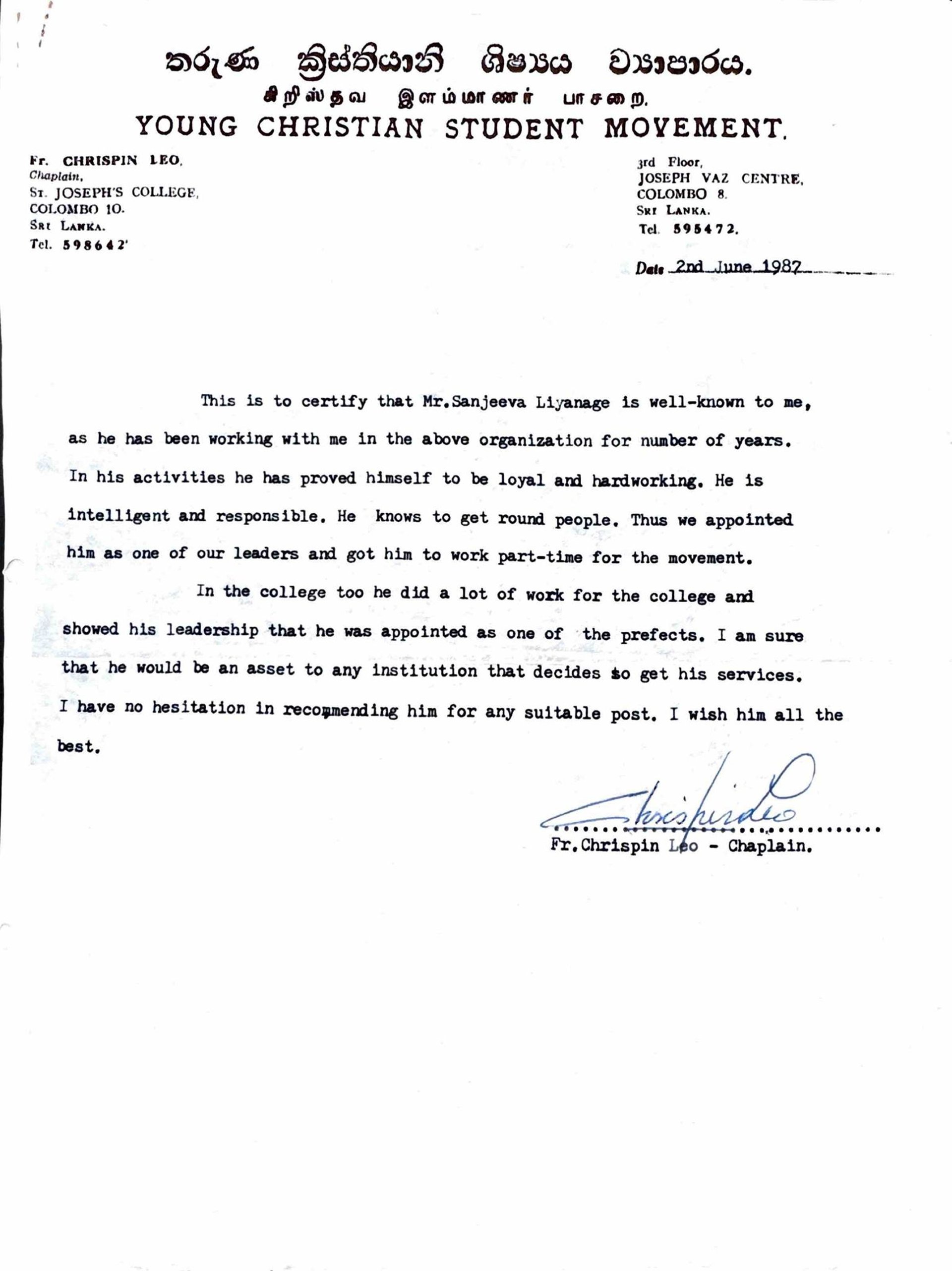
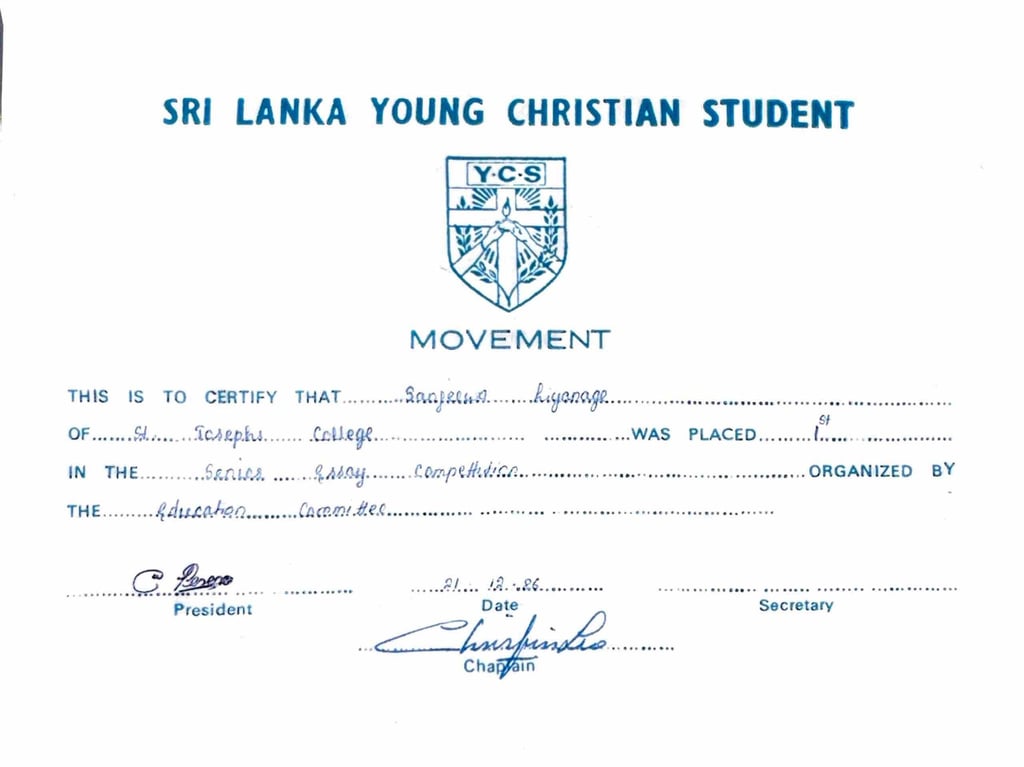
During those days, various committees were established in the Diocese with the objective of organizing events for members of YCS. I first became a member of the Education Committee. If I remember well, others in the Committee were: Saliya Pieris, Manouri De Silva, Rukmali Fernando, Mark Moraes, and Dushantha Abeysena. We met regularly to discuss organizing various events. I remember we organized an essay competition and a debate competition.
Our team worked very well. Saliya and I, despite many arguments and disagreements, worked well. Saliya was one year junior to me at SJC. But he was always a brilliant student. Saliya was a celebrity: he came runner-up in the Dulux Do You Know Contest — an island-wide quiz competition which was shown on TV. He lost the final round of the Competition to a girl from St. Bridget's! Manouri and Rukmali were cousins, and they both went to Holy Family Convent. Manouri, Rukmali, Mark, and Dushantha all lived around the Modara and Mattakkuliya area.
We had great dynamics in the team. We had frequent debates within the Committee on how to conduct its activities. I often remember Manouri and me on one side and Saliya on the other side. We three were the strong voices in the team. It was often this 2:1 situation that resolved many disputes. Today, Saliya is one of the leading defense lawyers in Sri Lanka. He teaches law and represented clients in famous cases such as the case of former Army Commander Sarath Fonseka and former Chief Justice Shirani Bandaranaike. Manouri too studied law. Saliya later married Manouri. I am in touch with both Saliya and Manouri, but lost touch with the rest of the Committee members.
Ardhakaaleena - Parttimer who were actually working full time ...
One of the most memorable times of my life was when I worked with the Colombo (as well as Negombo and Gampaha) regional Part-Timers' (in Sinhala, ardhakaleena) team. If I remember well, my best years were from 1986 to 1988, until I left Sri Lanka in July 1988.
The Colombo team bonded very well: we had Sriyan, Geraldine, Shiran Yatagama, Revanthi, Terance and Tyronne Perera (twins), Eymard, Edward, Thusitha, Dilruk, and Manouri. (I may have left out a few, and if so, my friends should please remind me!). We visited weekly cell meetings at parishes and schools and then, once a week, got together and reviewed our work and mostly tried to find solutions to issues. These problem-solving meetings were lifetime formation for me. I learned to deal with various problems, especially in relation to human relationships, and learned how to find ways to deal with them. We were an excellent group of facilitators.
Once, we found out there were some issues among our team, which was pointed out by a member of the Executive Committee of the Colombo region by way of a challenge. Actually, during that meeting, we were trying to resolve some issues, but this member challenged: "You have differences within your team, so before trying to solve others' problems, you could put your own house in order!" When this challenge came to us, we were surprised and did not know which part-timer this member was referring to. The challenging member was clever to keep it a secret, possibly to protect the privacy of the persons concerned as well as to make us work hard to find out “what was wrong among us.” This particular incident created a situation where we found we were all disturbed, as we thought we were a closely bonded unit. Obviously, we were not perfect. We had to find out what was wrong and fix it. And we were determined to discover the issue and resolve it.
How did we do it? We convened an overnight, intense self-awareness session. Revanthi managed to find a place: somewhere in the south of Sri Lanka at the residence of her brother-in-law, who was with the police. I think we were close to the police station, and in those days police stations were targeted for armed attacks by the JVP (Janatha Vimukthi Peramuna, or People’s Liberation Front, a Marxist youth organization that organized an insurrection against the then UNP Government). It was a risky move to have our session there. But we just took the chance, and we needed a place like that, away from our homes, to do this overnight exercise, which was revealing and completely successful. At the end of the session, we came to know about little things among us that had led to big misunderstandings by our junior members. We got to know each other better and bonded even better.
Gee Sandella
One of the memorable experiences we had was organizing a fundraising musical show called Ghee Sandella. We organized this at the largest indoor stadium in Sri Lanka, Sugathadasa Indoor Stadium. We printed thousands of colorful posters with all the famous singers in the country who were to attend the show. On the day of the show, we found out that most singers had cancelled or did not show up. Most people who were at the show were from the nearby areas of Kotahena or Grandpass, who were reputed to settle issues the way they wanted, then and there. We faced a very embarrassing situation. We were also quite worried! Would they attack us organizers? We had a popular band playing at the show, but half of the singers did not show up. Due to this, we had to fill the rest of the show.
And who came to the rescue? The band formed by YCS members of St. Peter’s College: The Horizons: Sriyan Wijeratna on keyboard, Edward Fernando on lead guitar and vocals, Senaka Perera on drums, and Shanika Fernando on bass. When they were introduced, the crowd was unsettled and greeted them with a hoot. But after they started playing, the atmosphere transformed completely. They played superbly, and the crowd loved them. They played Sinhala and English songs, and they saved Gee Sandella and us organizers!
AKa අකා, PuuKa පූකා, and SaKa සකා
Three Plus One
Enderamulla and Bopitiya
Kurunegala and Kandy
A crucial decision in the summer of '88