Always write and never stop writing



The Bicycle
Growing up as teenagers, bicycle was a big deal and we had so much fun with old-fashioned heavy and sturdy bicycles
STORIES
Sanjeewa Liyanage
5/12/20094 මිනිත්තු කියවන්න
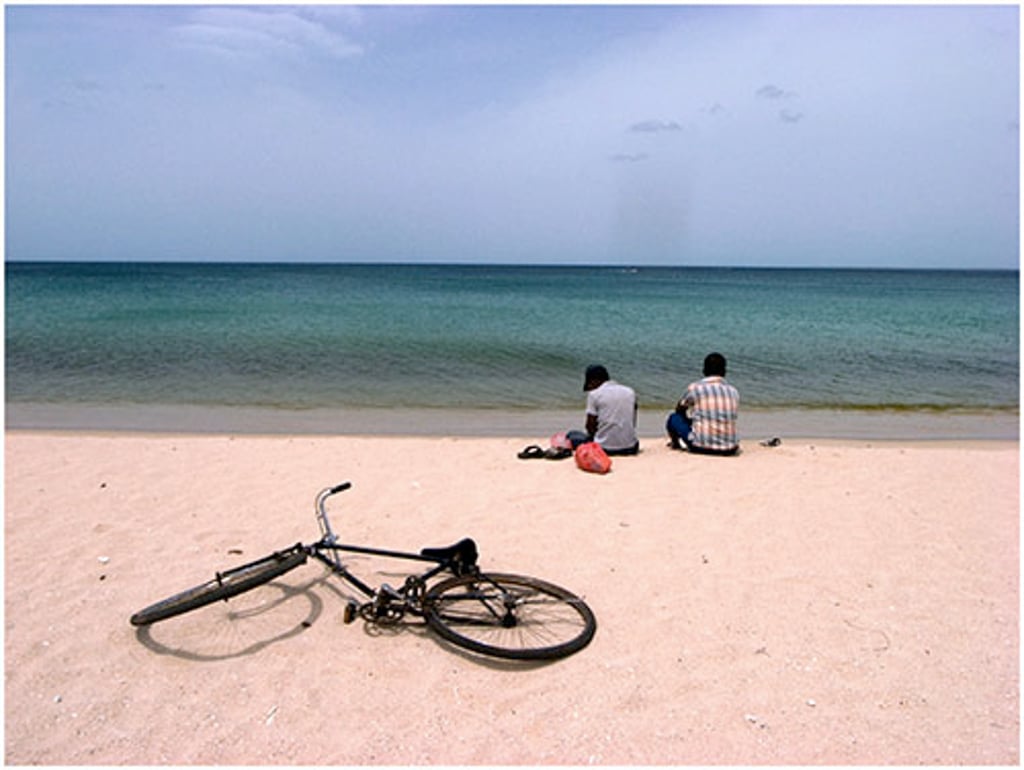
I was talking to my best friend recently about what we had in our families when we were young. In Sri Lanka, having your own car is still considered a luxury. Twenty years ago, it was even more of a luxury. I was talking to my best friend Eymard recently. When I visit Sri Lanka, Eymard often picks me up from the airport, as well as takes me to the airport when I am leaving. He comes at those odd hours to pick me up or to drop me. He has his car. My sister has her car as well. Almost all my friends have cars. Our relatives have their own family cars. But in those days, when we were growing up, we had no car. The only thing we had in our household was a push bicycle.
It was my father's Raleigh bicycle I remember first. It was a valuable piece of property we had. Its body was reputably strong. Its paint was peeling off. But whenever he had some money, my father used to take this bicycle to the bicycle repair shop in the Balagala area to replace its parts. I enjoyed this part the most. I was an admirer of this skilled young man who was just wearing short pants with grimy fingers, doing magic with his hands. His hair was frizzy. He was dark. But his face showed that he was a master at what he was doing. He was also the person who was servicing the racing bicycles of Boniface Perera, the national cycling champion in those days. He was working at that time at the Ceylon Tobacco Company, where my father had just started working as a security officer. Bonnie, as the villagers called him, had the biggest and fittest thighs I had ever seen. He had a kind face with big eyes and notable sideburns.
At the bicycle repair shop, I was watching how the repairman, I think his name was Basil, was replacing a whole set of spokes, replacing freewheels, replacing ball bearings, and how, after putting dark green-grey grease around the area where the ball bearings were to be placed, he would then stick the ball bearings one by one, one after the other. After that, he would insert the axle gently into the middle of the wheel and tighten the bolts before fixing it to the bicycle frame. In those days, I was perhaps 11 years old and could stay at the workshop for hours watching this magic.
When the bicycle got new parts, it was a whole different feeling. You could feel how smooth the bicycle was on the road, and especially when there was a new freewheel, you enjoyed listening to the sound of the freewheel when you back-pedaled or stopped pedaling when the bicycle was on the move. This was the bicycle my father used to ride for years. I still remember he rode this bicycle from Panagoda Army Camp to Hendala. I think the distance was about 40+ kilometers. But he rode it like nothing. He had clips to clip his trousers when he rode. I remember those red plastic clips. I even remember he brought home a shotgun carefully wrapped in a cloth and then a jute bag. This gun was then tied to the horizontal part of the frame of the bicycle, allowing the gun to hang from the frame. No one would notice that it was a gun tied to the bicycle frame due to the way it was wrapped. He then showed us the gun. The gun was at our home for a few months. Before retiring, he took it back to the camp and left it there. Later, he regretted that he did not keep the gun when the government began to issue licenses to unlicensed guns. But I also told him that it was good that he did not have the gun because, during the late 1980s, the JVP used to obtain information on who had registered guns and came looking for them to be used for their activities.
This Raleigh bicycle is also the bicycle we used to learn how to cycle. I still remember the day I learned how to balance the bicycle. I felt like I had learned how to fly. I rode the bicycle around our house nonstop for hours. Same for my younger sister. I still remember a photograph of my sister riding this bicycle, left leg on the left pedal, right leg awkwardly placed on the other pedal but through the triangular frame of the bicycle, as our legs were not long enough to ride over the horizontal bar of the frame. So when we were riding like that, it looked awfully ugly. But we did not care, as we felt like we had been given wings, and we did not care how our flying looked. We just wanted to fly!
After a while, through the Ceylon Tobacco Company, my father managed to get a brand-new bicycle. The old one was sold for a paltry sum. The new one was given, and the price of it was deducted from his salary over a period of one year or so. The day this bicycle was brought home, it was like we had our new car. The effect was the same. Its paint was new and glossy. All steel parts were bright and shining. It had all necessary accessories, including a dynamo, light, and rear rack to place anything to carry on it. It was PHOENIX brand, which I later learned was from China. I have seen this brand of bicycles in China. When I saw them during a recent trip, I felt nostalgic.
During the first few months, we used to keep this bicycle like the most precious thing in our lives. Indeed, it was the most precious and interesting thing we had at that time. We cleaned and wiped the dust off the bicycle almost every day to keep its new look. But this practice receded after a few months.
My father used to ride this bicycle to go to work. His workplaces were around the area of Kotahena, so the distance was not that much, say around 9 kilometers. But he rode this bicycle at odd hours. He was on shift duty, so he sometimes left at 10 p.m. to begin his 11 p.m. shift. Or, he would return at midnight after his 11 p.m. shift. Or he would leave at 6 a.m. to begin his 7 a.m. shift.
Unlike sitting on the rear rack of the bicycle, a second person would travel sitting on the horizontal bar of the bicycle. This has been a peculiar style practiced in Sri Lanka.