Never stop writing

Meeting the Boy's Mother
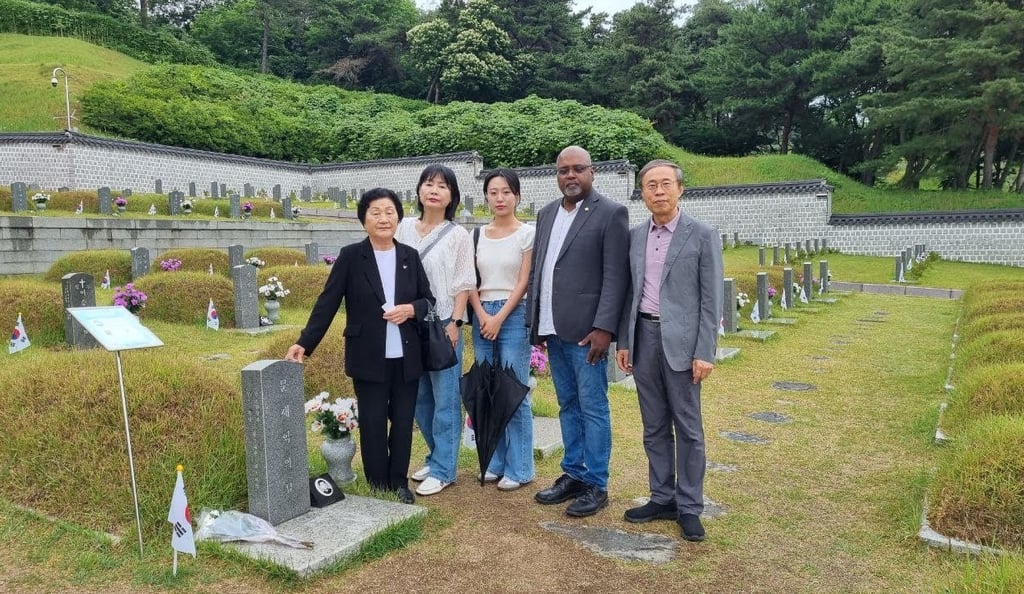
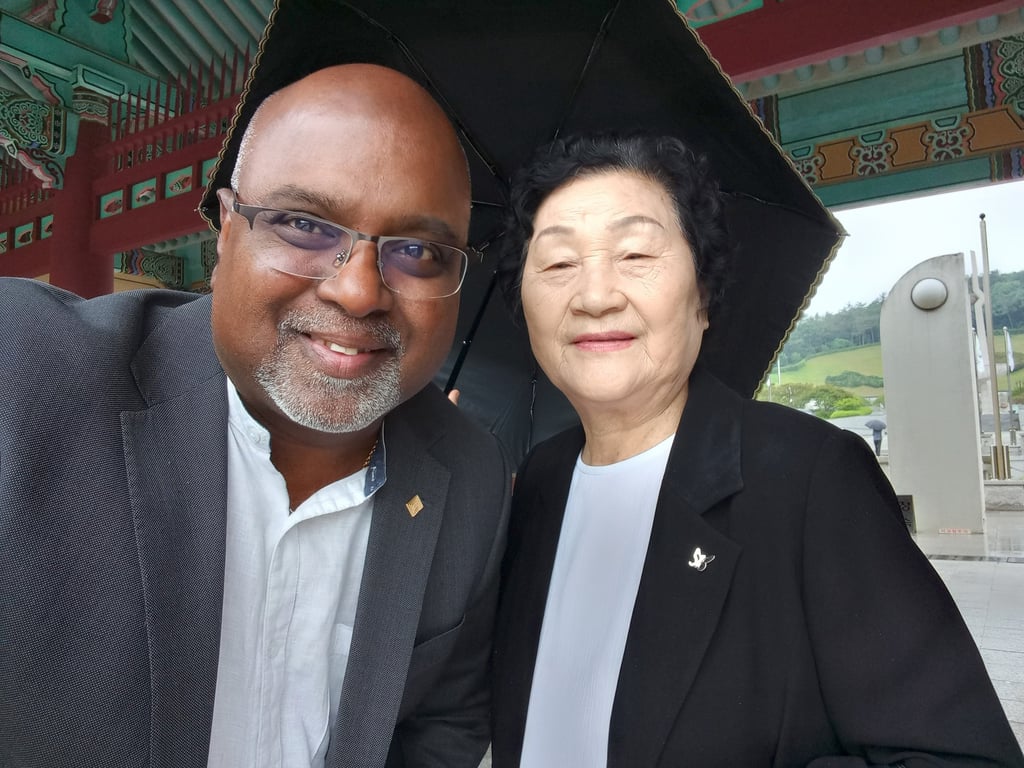
Hang Kang in her book Human Acts refer to her as "boy's mother." And its a real person of a real boy who was killed by the South Korean military in Gwangju. He was one of the youngest to be killed. And this is my encounter with boy's mother at the grave stone the boy.
STORIESSHOW IN HOMEPAGE
Sanjeewa Liyanage
6/22/202510 min read
22 June 2025
Today is my late mother’s birthday. She would have been 79 (or 80) today. A few weeks ago I met Kim Gil-ja. She is 86. She is the boy’s mother. The boy is Moon Jaehak.
I have written earlier about Human Acts by Han Kang. While the English translation was published as Human Acts, the original title in Korea was The Boy is Coming. In the last chapter of the book, Han Kang narrates how the book came about. Han Kang has not only researched and read much about the Gwangju Uprising, but she has internalized it so deeply that I feel she is living the pain of those who suffered and died or survived. That is apparent from the dreams she described in the last chapter. As I wrote in my earlier article, when you see Han Kang’s face full of calm and settledness (need a different word to describe than this one), you also see pain and suffering, kind of engraved in her. An author who has internalized and is living the pain!
A few months ago I was talking with a friend in Seoul about the book. Only then he revealed something I did not know until then. “Sanjee, you have met her!” I was not sure what he was talking about. I asked him, “Not sure what you mean, whom have I met?” “You have met the mother of the boy more than one time in Gwangju.” Then only I realized what my friend was referring to. I tried to recall many faces of mothers who have lost their children, whom I have met again and again since 1996 when I first visited Gwangju. But I could not make out which mother he was referring to. But it was a revelation. So, I have met the boy’s mother! I wanted to meet her again. I know it was an impossible task to meet Han Kang now, although I know I will meet her one day. I talked to my friend and brother from another mother, Lee Jae-eui. “I will be in Seoul for a few days in June and thinking of coming down to Gwangju for a few days. Can I stay at your home?” Jae-eui was so happy to hear this. Coming to Korea and not visiting Gwangju is like going to a familiar town and not visiting the home you lived in there. If I left Seoul without visiting Gwangju, I would feel that I have missed something and would regret it.
I first met Gwangju mothers and fathers who lost their children, brothers and sisters who lost their siblings in May 1996. It was at Mangwoldong Old Cemetery where their family members have put to rest the remains of their loved ones. I still remember the events of that day, the makeshift tent and family members gathering to pay respect on the 17th and 18th May. On the 17th May, it was a private ceremony of the family members only. On the 18th May, a more formal ceremony. In May 1980, I was at the old cemetery on the 18th May with a number of foreign youth who had come there to witness this sombre commemoration. Next to each tombstone was a small memorial, a transparent box made of glass or plastic in which a photo of the deceased and some items belonged to them, like a watch, handkerchief, a book, etc. On the leftmost side of the cemetery was a kind of notice board with photos of deceased whose bodies were yet to be found—the military had disposed of their bodies in unknown locations! There was singing of the March of the Beloved, the song that I once thought was the national anthem of South Korea.
Then I visited Gwangju in mid-May almost annually, in the late 1990s. In 1997, the National Cemetery with a gigantic memorial was opened and remains of most of the deceased were dug up from Mangwoldong and transferred there. It was at the National Cemetery I remember taking part in both private commemoration on the 17th May and the public and more official one on the 18th May. It was there I got to see up close and even meet many of the former presidents and prime ministers of the country, like Kim Daejung, Roh Moohyun, Moon Jae-in (and even Park Geun-hye!). Among the two joint commemorations, the one on the 17th May was more sombre and emotional. All mothers were dressed in white hanbok, the Korean traditional dress, and fathers in black suits. At that time, the Association of Bereaved Family Members was led by Chung Sooman, who often led the commemoration. Kim Gil-ja and many other family members were there. The ceremony often starts with a dance or music performance to honor the dead. During the ceremony, the mothers, fathers and siblings of the deceased would line up to lay white flowers on the altar by the huge monument and then add incense to the urn-like pot by the altar. After they finished, I would join a few other non-family members to do the same, and often wear white cloth gloves before laying flowers. I would then go and meet some mothers and fathers and try to speak with them if I had someone to interpret. When the ceremony was over, each family member would climb up the steps to the cemetery and put flowers by the tomb of their loved ones. This was the hardest part. It is at this moment I would see many mothers weeping by the gravestones, often hugging them, relating memories of last moments they remember before their loved one departed. I have repeated this more than 10 times from 1996 to 2006 when I moved to Europe, and then again in 2012, 2017 and 2018. In 2018, I took along my 17-year-old daughter to join me to pay respect to the fallen heroes or martyrs of democracy in Gwangju.
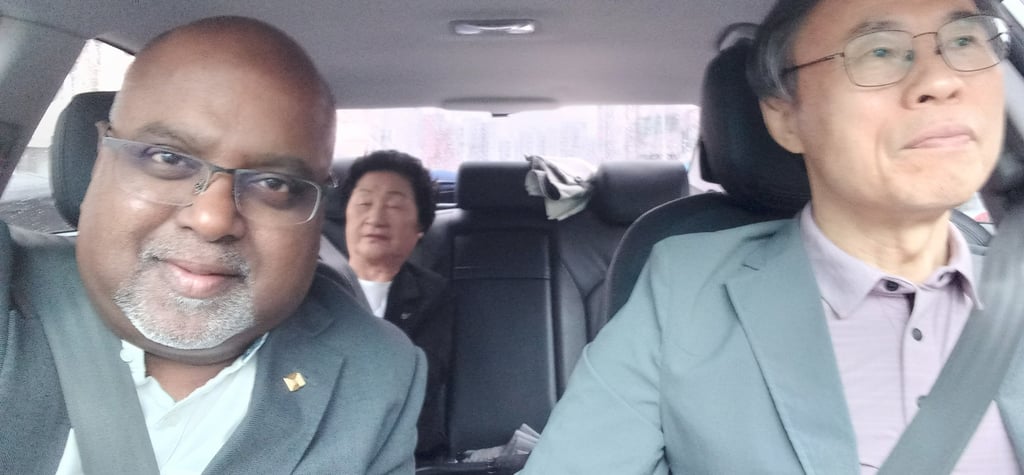
On that rainy and gloomy Friday in early June, I left the home of Jae-eui with him, first to pick up Kim Gil-ja who agreed to go with us to pay respect to her son at the cemetery. Mrs. Kim, wife of Jae-eui, had woken up early and ironed one of my white shirts in preparation for this journey. I asked Jae-eui whether I should wear my suit jacket and he said that would be appropriate. We then drove and parked the car close to the house of Kim Gil-ja and waited. Soon, the mother of the boy appeared, wearing a white blouse and black skirt and a handbag. She looked well for her age, 86, and walked without any difficulty or aid. She had put on makeup and looked well prepared to see her son. She sat in the back seat and we set off to the cemetery. Jae-eui reminded her that I am no stranger to Gwangju and have been visiting the city over 30 years and have met her and other mothers during these visits. Jae-eui kept speaking with her in Korean on the way to the cemetery.
We first went to the flower shop and bought two sets of flowers, one for our good friend Soh Eugene and the other for the boy, Moon Jaehak. I first went to the old cemetery to look for Eugene. It took us a little time to find him and then I saw his smiling face engraved on a stone by his tomb. I laid some flowers and told him I had come to see him and asked him to sleep peacefully. Last time I was here in May 2018, I remember Eugene taking my daughter, Aakashi, through the old cemetery and relating the history behind this unique place. He passed on 16th May 2019 and later his ashes were interred in the same cemetery where we last met in 2018.
Thereafter we drove to the parking lot of the main cemetery. It was raining lightly and was very quiet compared to other occasions when I have been here during the commemoration times of the month of May where hundreds of vehicles, and thousands of people, metal detectors, security clearances, etc., were present due to the frequent presence of the country's president at the official commemoration event. When we were getting out of the car, we ran into Gil Taek Lim, who is connected to the 5.18 archives and also acts as a guide to those visiting the cemetery.
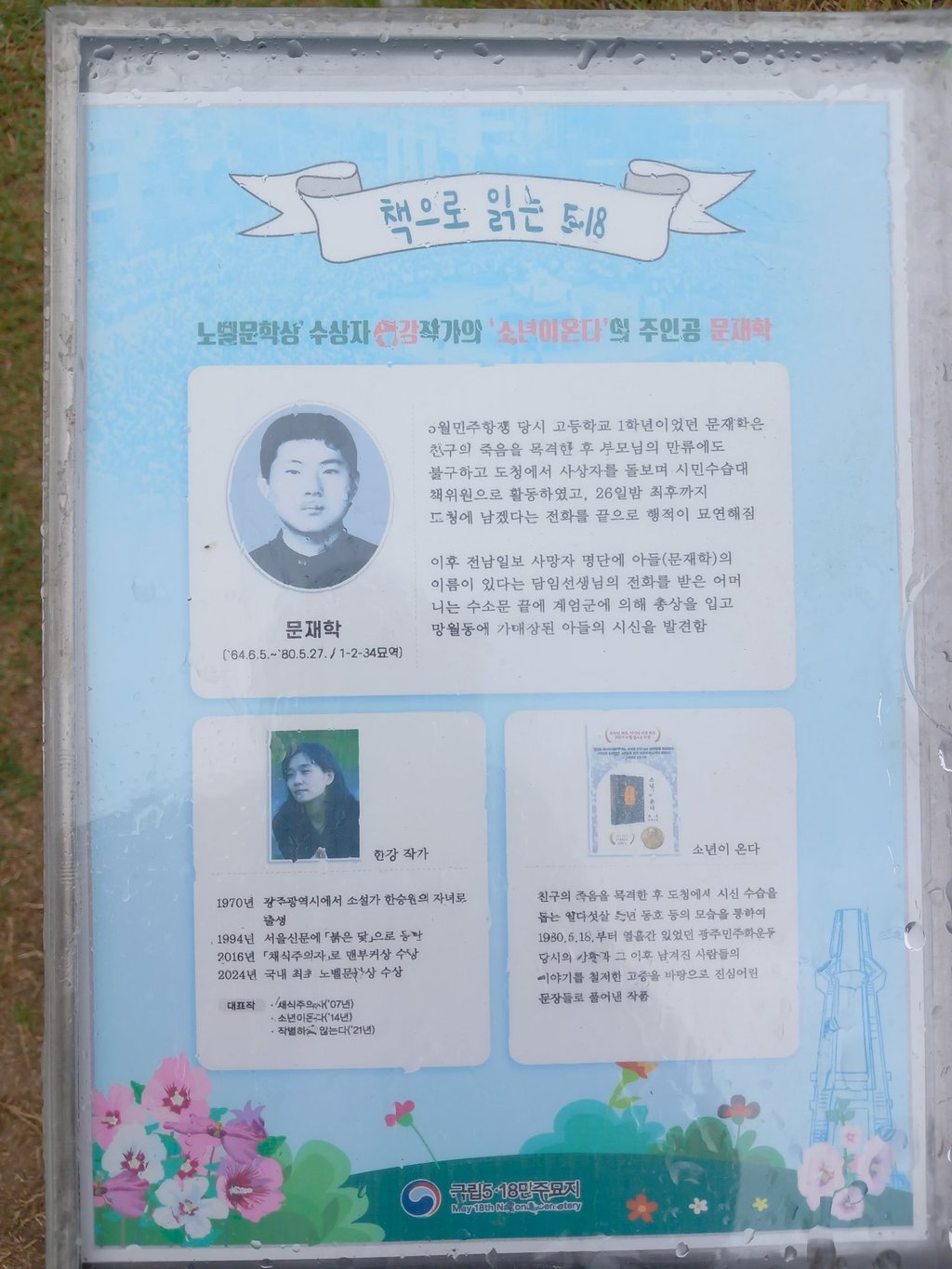
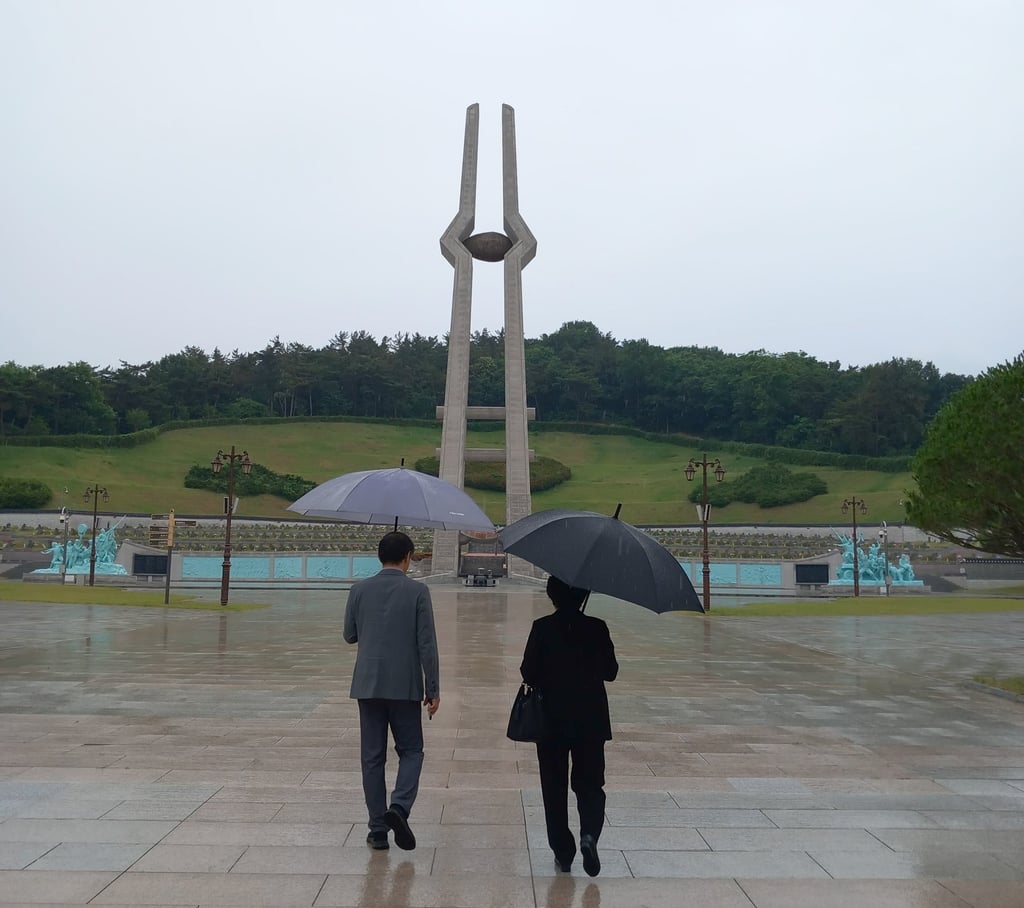
Jae-eui, Kim Gil-ja and I started walking towards the monument under our umbrellas. While we were walking, March of the Beloved was playing through the speakers of the cemetery. We paid silent respect by the altar and headed straight to the tomb of Moon Jaehak. Surprisingly, there is a little additional plaque with the photo of Han Kang and Jaehak reminding that this is the boy in Han Kang’s story in the book, The Boy is Coming or Human Acts.
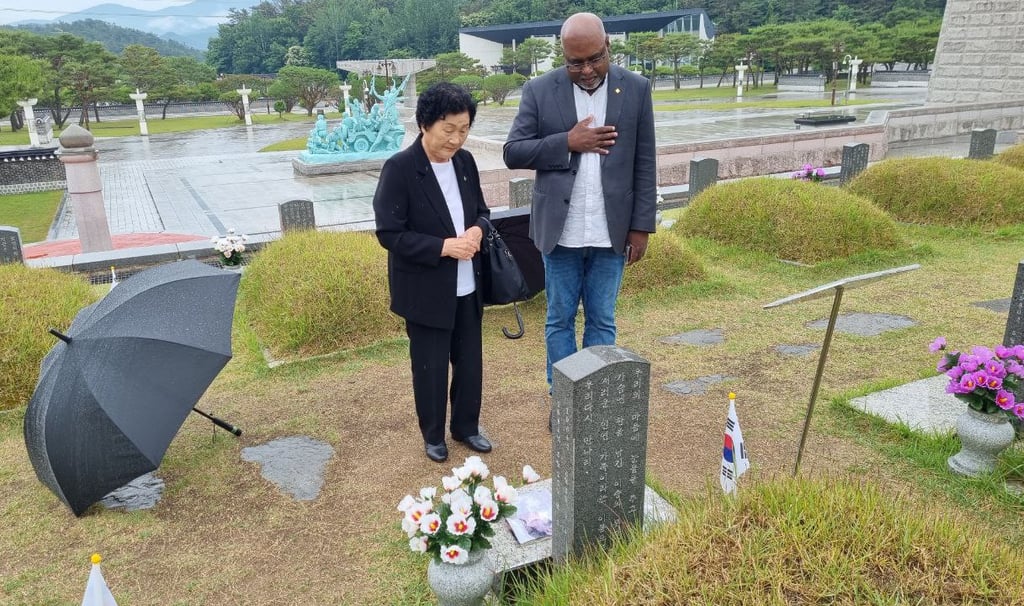
We put the flowers by his tomb and said a silent prayer. Kim Gil-ja then looked at the photo of Moon Jaehak and told him, “Jaehak, he has come to see you from Switzerland.” And she kept talking to him and I did not want Jae-eui to translate everything. But one thing Jae-eui managed to translate stuck in my mind: “I went three times to meet him and bring him home! I talked to him and asked him to come home with me. But he refused and asked me to go home.” I told Kim Gil-ja that “your son is living among all of us! He has given the gift of freedom for many in the country. It was your personal loss that has mitigated greater gain for many. So he is not an average young 15-year-old, a courageous hero, and I am very proud and humbled to visit him with the mother who gave birth to this remarkable young man!” I am not sure whether my words meant anything to her. For a mother, losing a young son is terrible, something I will never be able to understand. The pain! But at least I wanted to tell her how I felt.
Before we left, Gil Taek Lim and his colleagues were coming towards us with a mother and daughter. They were readers of Han Kang’s book. Apparently, after the popularity of Han Kang following her Nobel Peace Prize, many of her fans started coming to the 5.18 National Cemetery, especially to the tomb of Moon Jaehak. I found this a new practice! Not sure how Kim Gil-ja finds these new visitors to her son’s grave. I hope she feels happy that many are visiting him now more than before and many are commemorating his short-lived life. Before leaving the cemetery, I gave her an ivory-colored silk scarf I received from a Tibetan monk. I told her to keep strong and thanked her again.
When we left the cemetery, it was raining a bit heavily. Jae-eui kept talking with Kim Gil-ja until we dropped her off at her home. She thanked me for coming and I told her that I am the one thanking her. We bid farewell and left her. She waited until we left and waved her hand while our car was leaving.
I felt quite overwhelmed by the morning. A lot of feelings, emotions and reflections have overwhelmed me. One thing I was sure of was that I felt that one of my duties is over for now—to visit the cemetery to pay respect to fallen heroes of the Uprising. This is something I have to do if I visit South Korea, and in particular Gwangju!
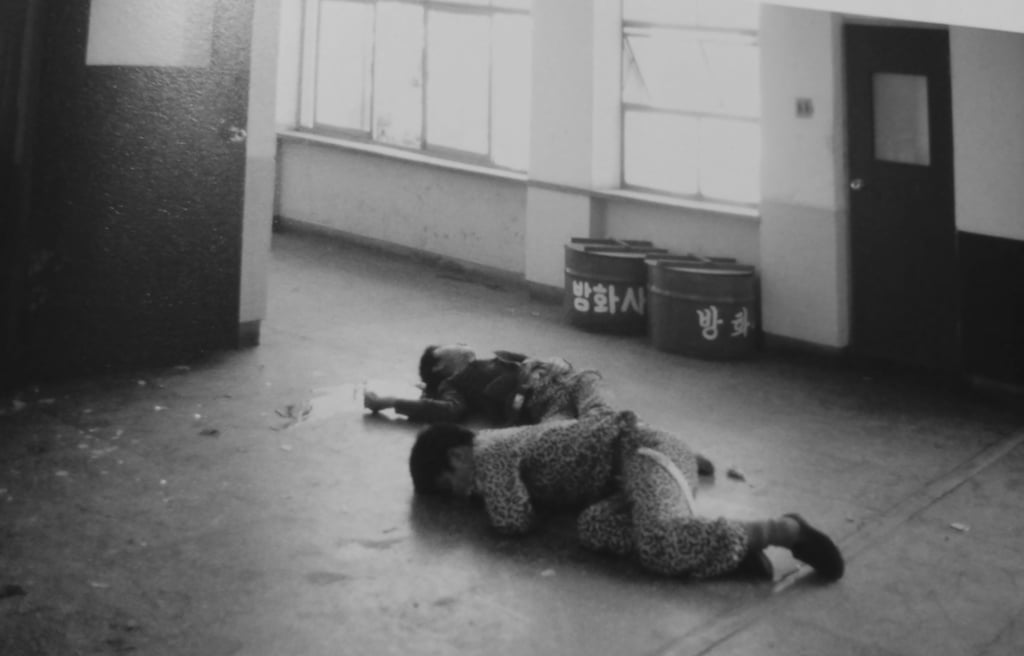
In the evening, Jae-eui was trying to book my bus ticket online to get to the Incheon Airport from Gwangju. While he was at this task, I was browsing his bookshelf and one particular book caught my attention. It was a grey-colored book with a hard cover that featured photos by Norman Thorpe, the WSJ photographer who was present in Gwangju in the evening of 26th May 1980. When I browsed through the pages of the book, I was shocked. I was seeing photos I had never seen or published. Thorpe had taken so many photos. And some of these rare photos had been the property of WSJ until 2021 when the Gwangju City wrote to the newspaper and bought rights to publish them. I was especially shocked to see never-before-seen photos taken inside the Provincial Hall building on the morning of the 27th May 1980. I am not sure how Thorpe, a white foreign journalist, got access to the building and shot that many photos. Jae-eui is analyzing these photos to build a timeline. He is looking at every possible clock visible in the photos to see when the photo was taken. These are solid evidence for Jae-eui’s lifetime fact-finding work related to the Gwangju Uprising and the Massacre.
Then I came across a couple of photos taken inside the Provincial Hall–two young men dead, guns next to them, and blood visible (I have made the photo blur and darker out of respect for the departed!). They were like sleeping after a tired overnight battle. Sleeping eternally, in deed! They were wearing military training uniforms. Right next to them were a couple of pieces of bread. The last thing they were holding was bread? And shockingly, Jae-eui would then tell me that one of those kids was Moon Jaehak! My day had already been eventful and then this dramatic revelation. This photo was published in 2021. Han Kang wrote the novel in 2014. This morning, in the car, Jae-eui had told Kim Gil-ja of the existence of the photo. She had told Jae-eui that she had no courage to look at it!
Once again, I am ever grateful to Lee Jae-eui for arranging the visit and coming along. Without him, I would not have been able to do this alone.