Never stop writing

Playing hide and seek in cemeteries and other stories
My childhood has strange experiences, going to a premiere Catholic school and hanging out with privileged classmates from Colombo and then going back to a small village like town and then hanging out with local children in the neighorhood.
STORIESSHOW IN HOMEPAGE
Sanjeewa Liyanage
2/6/201110 min read
6 February 2011
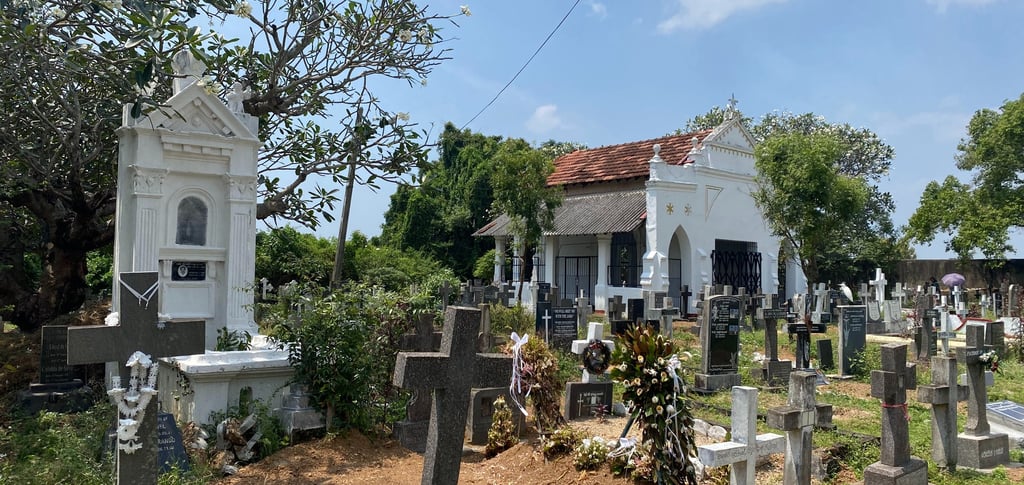
I grew up in Hendala, Sri Lanka. Our house was situated between two Catholic graveyards. Our house was the fourth house down Pokuna Road, behind Nayakakanda Public School. We were among the first to inhabit this area, which used to be full of cashew trees in the late 60s. My maternal grandfather, Siebert Fonseka, bought two plots of land, adjacent to each other, for my mother and her younger sister, Kanthi Punchi. My grandfather came from Hendala, and his father was a well-known person in the town. My great-grandfather was called Bethan (Bethan Aiya or Bethan Seeya), who used to be in the business of funeral bands.
I walked past these graveyards at least twice a day. Familiarity with these graveyards helped me to overcome the common fear among people of graveyards. One of these cemeteries, the newer of the two, was behind our garden. There was a thin strip of land between this cemetery and our garden. This means we could very well see concrete or wooden crosses in the cemetery from the backyard of our house.
The gravedigger lived across the fence from our garden. They lived just next to one of the cemeteries, the one at the back side of our home. The old man was called Santi Aiya, and his second son inherited the same profession after he passed away.
Building the house
The land where we had our house at Pokuna Road was actually a jungle with cashew trees. The land was cleared, and a layer of soil was removed to bring the land to the level of the descending Pokuna Road by the piece of land. So two sides of this rectangular land gave the impression that the land was in a pit. The soil was red, and the earth was hard. We called the formation of the earth in our land kabok, red hard rocky surface, which was very hard to dig into. So digging the ground to set the foundation of my house was a very tough job. Of course, there were workers from the area readily available to do such hard jobs, to which they were very used. The foundation of the house was laid in red bricks. I still remember hundreds or thousands of bricks unloaded and stacked on one side of the land to be used for the house. These bricks were transported from the Welivita area, where my father came from. That area by the Kelani River happened to have ideal soil to make red bricks. The other area from where we brought bricks was the area between Negombo to Chilaw (or Halaawatha) or Puttalam (or Puttalama).
When the soil had to be extracted to set the foundation of the house, that was also a big deal. You could not just go and start digging the land. It had to be done at an auspicious time. A wooden tripod was created at a corner of the land.
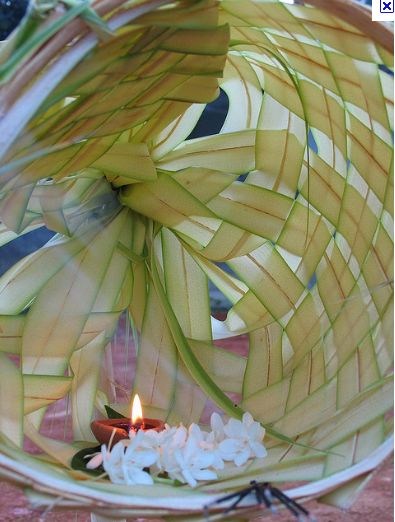
On this wooden tripod, a gok kola (yellowish tender coconut leaves) was placed, and pichcha flowers and a wooden oil lamp were placed inside this basket. Then the first stroke on the ground to dig the soil was made facing a prescribed direction at an auspicious time. The rest of the work began only after that. It was very interesting to see how superstition was affecting a Catholic family like mine. Although the Church discouraged such rituals, they were common among Catholics or Christians. Symbolism is there in Catholic traditions too: statues, rosaries, and crosses are common symbols we used. One would use an auspicious time prescribed by a Buddhist astrologer to bury a small metal cross in the cement foundation. That was how various religious symbols played an important role in each one's daily routines. For example, during the feast of St. Sebastian in June, Buddhists and Hindus in the area too would contribute food and drinks to people taking part in the large procession.
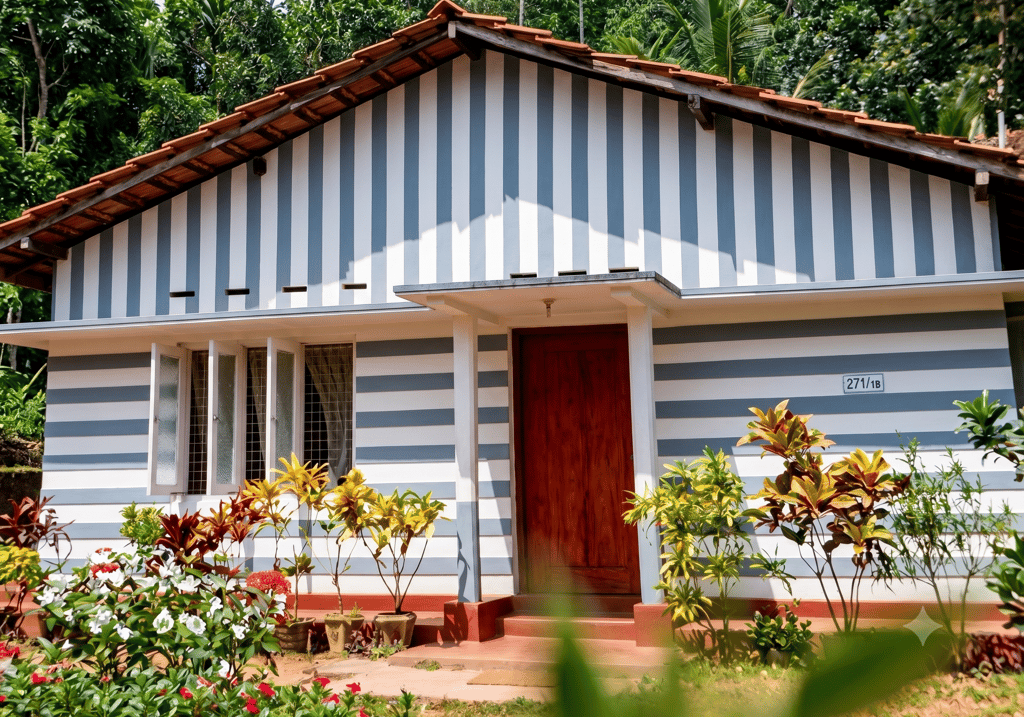
There are so many memories around that house at Pokuna Road, 271/1B, starting from building it. When we began building the house, we used to frequently visit the site. We were living at that time in Kolonnawa. We would take bus 152 from Kolonnawa and get off at Grandpass, which was also called by the not-so-attractive name Kunu Mola (Garbage Factory). Then we would take the stairs down and walk towards the Sugathadasa Stadium to take bus 107 Elakanda or 260 Hendala. Then we would get off at Nayakakanda junction and take the 10-minute or so walk, passing St. Mary's Church, the sports ground behind the church, and the cemetery.
My interest was to watch every step of the construction of the house. I watched how the laborers mixed cement, sand, and hunu with water to make the mixture to bind bricks together. I watched how the masons used primitive instruments to keep the brick wall under construction straight and
Those days, the land after the old Catholic cemetery was a cashew grove. It was during later years, especially around 1977, that trees were cut, the land was cleared, and the land was flattened to make the present-day Elle Sports Ground. It was fascinating to see how bulldozers were moving the earth to flatten the land. That was the playground where I played elle almost every evening with Sarath, Nimal, Jagath, and others. We had such fun in those days. I really miss playing elle. This was also the ground from where I ran home when I forgot the time set by my father to come home in the evening, 6 p.m. I would get carried away so much by the game with Sarath, Nimal, and Jagath that I would often forget to get home in time. I would be reminded by the sight of my father appearing by the grounds with a stick in his hand. Then it was a skillful effort to evade my father, pass him, and run down Pokuna Road towards home. I would get beaten.
My passion for elle increased when the host elle team, Matagoda Ananda, organized a huge elle tournament in that playground. Elle matches would take place on Saturdays and Sundays. I was always there, not wanting to miss a single match, standing under the scorching sun. Often my father joined me too. But it was such a fanfare. The elle tournament had teams from the coastal area all the way up to Chilaw or Halaawatha. However, the favourite teams who ended up at the semi-final stage were Thotalanga ARUNA, Hendala (Palliyawatta) SAGARA, Kerawalapitiya MUDITHA, and if I remember correctly, Maataagoda ANANDA. However, my favourite among these teams was Muditha. Some of those players, like Cyrus Alwis, in the team were my heroes. Some could hit the ball beyond the ground, on the left towards the Government School or the old cemetery, towards the front beyond the cliff at the end of the ground, and on the right towards the houses of Lenora's and the new cemetery. And the wonder was that there were fieldsmen who would field beyond the ground, sometimes on the road just behind the bice-poles or bice kanu (two arecanut tree trunks solidly planted on the left and right of the player who struck the ball or batters, delineating the scope of his stroke).
[This post is not complete. I have much to write on the following topic areas, and finding time to do so is a challenge.]
Renovating the house
Our house was one of the simple ones. Three bedrooms, one living room, dining room, and a kitchen. According to the original plan of the house, a large kitchen was to be built. But my parents did not have enough money to complete the house. The house did not have a ceiling. When it rained, we had to put buckets under dripping water from gaps between tiles. But after my father retired from the Sri Lanka Army and was immediately employed by the Ceylon Tobacco Company as a Security Guard, the easiest job an ex-serviceman could get, he managed to get a loan to complete the house. This included building a fairly large kitchen with pantry cupboards, a cooking stove with a chimney, and tiled walls over the pantry cupboards. Again, I was keen to see through the whole process of making concrete using bamboo instead of iron and the whole process of carpentry work, all done by a young son of the mason who built the house at first. This young man's name was Peter, and I called him Peter Aiya (elder brother), and he was sort of my hero, as I saw him doing magic with all masonry and carpentry tools. And after returning from school, I helped too and learned how to build a brick wall, plaster a wall, make a cement mix, and do all sorts of carpentry work. Such experience really helped me to mend things later in my life. I seldom like to throw away a broken thing, and the first thing I would do is try to repair it myself.
Kalawan Malluma කලවම් මැල්ලුම or mixed green leaves salad
A variety of plants and trees occupied our back and front yards. There were anguna kola අගුණ කොළ (a dark green leaf that is extremely bitter), passion fruit vines, and various other leaves. My father passionately grew them. And on Saturdays, he would pluck tender leaves from most of these plants to make a mixed green leaves salad/mallum (thinly cut green leaves mixed with thinly cut onion, scraped coconut, fresh green chillies, salt, and lime juice), which we called kalavam malluma (mixed malluma). We did not really like this, as it was quite bitter, especially due to the presence of anguna kola. But we were strongly encouraged to eat it. Our father told us, "To have good eyesight, eat kalavam mallum."
We had banana, papaya, jackfruit, and mango trees in our garden. Our backyard was rather small, but it had quite an interesting collection of trees, including a couple of coconut trees.
Hen Pen and Kalukuma (කුකුල් කූඩුව සහ කළුකුමා)
Kalukuma කළුකුමා is the word for turkey in Sinhala. Those days, we owned a few roosters and hens. These gan kukulo (literally village roosters) were strong and colorful. My father built a strong wooden pen for them in the backyard. First, he dug a rectangular pit about 4 x 6 feet in size. In the corners of the pit were 3" x 3" wooden poles, and on them, about 2 feet above the ground, we built the pen. It was, in fact, a little wooden house. He built it from scratch. I helped. All we needed were a measuring tape, saw, and hammer. We bought wooden planks, chicken wire, bronze hinges, a few screws to fix them, and a lot of different-sized nails from the hardware shop and built this quite large chicken house, or kukul kuuduwa, in a day. What fun doing that! That handyman thing my dad had was naturally passed on to me. Even now, there is a lot of passion in doing something of that sort.
The floor of the kukul kuuduwa had wooden planks fixed with about 1/2 inch distance between them so that the chicken droppings could be easily scraped or swept through them to the pit below. The pit below was also used for compost waste and later used to fertilize flower pots and various plants around the garden.
The roosters and hens would freely walk around in our garden during the daytime. They would jump out of the door when we opened it in the morning and walk around the whole day looking for worms and the like, which were plenty. A hen mother would scratch the earth to uncover little worms to feed the flock of chicks that was following her and learning from every move she made. At around 6:30 p.m., just before it became dark, it was time for them to go back "home." There was a small ladder for them to climb up to the kukul kuuduwa, especially for the chicks. The big ones would fly up through the door. If a few were missing, our task was to locate them and usher them towards the pen and then shout kuudu kuudu (by which we meant "towards the pen, pen," and don't know whether they understood this or not, but we thought they did!), and they would then fly in. It would take a while to chase around a few stubborn roosters to get them into the kukul kuuduwa sometimes. Then the kuuduwa would be locked, and some feed and water would be placed for them to eat at night.
We also made hens prepare eggs to be hatched. It was always amusing to see the little chicks coming out of eggs after about 29 days of a hen sitting on them. We also put a light bulb on a pot of eggs and would have chicks in about 29 days.
Once, someone gave us a few turkey eggs. We managed to hatch them, and it certainly took a bit longer than 29 days. There were about six turkeys. They were not as lovely as chicks. They were quite ugly. There were about six of them. But then feeding them was a challenge. Many people told us different things, such as to feed them boiled chicken egg yolk and papaya leaves, which we did. I think we spent a lot to bring up those turkeys. However, as I remember, they did not grow that fast, and I don't remember what exactly happened to them. I only know that they got special treatment, and they got along with other roosters and hens in the kukul kuuduwa.
Those were the days we had eggs from the pen, which we called gam bittara — village eggs. Generally, gam bittara shells were orange-brown, and egg yolks were dark orange-yellow. The eggs with white shells were called farm eggs, which came from broiler hens mass-producing them in chicken farms, and their yolks were more yellow than orange. Orange eggs were a bit more expensive than white eggs. Before a hen laid an egg, she would start shouting like crazy and walk around restless, her beak open like she was very thirsty. We had to train the hens to go to the pen to lay eggs. Otherwise, they would find some place in the garden to lay eggs. Occasionally, we would find a few eggs laid by a hen in a small bush after a few days.
Roosters often grew up and sacrificed their lives during a special occasion. In our home, it was either Easter or Christmas. And I remember that in those days, when chicken was not in mass production, the price of chicken was higher than the price of beef/pork. I am talking about the 1970s, and industrial chicken production was just starting or not very popular. So, the price of gan kukul mas was expensive. So, at our home, we had beef more often, pork during some weekends, and chicken less often, mostly on a special occasion.
To be continued with following sections ...
Saturday morning routine
107
Sumana Stores
Funerals, eulogies and Wilbert Weda Mahaththaya and Norbert Mawalage
Funeral of Shelton Jayasinghe
Funeral of my grandfather
Funeral of Geetha Punchi
Kaju Kale which became the elle sports ground
Playing elle with Sarath, Nimal and Jagath Lenora
Watching the great elle tournament
Weaving mill
New school being built
Fonseka Master
San Christian
Jose Aiya
The man who fell into the well
Two big buckets of water and two hundred yards
Mr. Riverse
Birthdays and ballroom
Christmas Carol--"My father sent it from abroad"
Demala Kade
Mas Kade and Paulu Aiya
Miris Mola
Public Bath Well
Coupon Potha, Salaaka Card Eka and Samoopakaraya
Janaka, Rogan and Tino
Legion of Mary and Alter Boys' Association
Manike Aunty
Istharan
Bicycle races and Boniface Perera aka Bonnie
Playing cricket on church ground and Chaminda Vaas