Never stop writing

Thirty years of Gwangju Spirit Inspiring Asia and the World
About how the spirit of Gwangju, born from the May 1980 uprising and massacre, grew beyond Korea to inspire human rights, democracy, truth-seeking, and solidarity movements across Asia and the world. About a thirty-year personal journey of connecting Gwangju’s struggle with victims, families, activists, and civil society movements from Sri Lanka, East Timor, Cambodia, Myanmar, and beyond.
REFLECTIONS
Sanjeewa Liyanage
5/18/202610 min read
18 May 2026
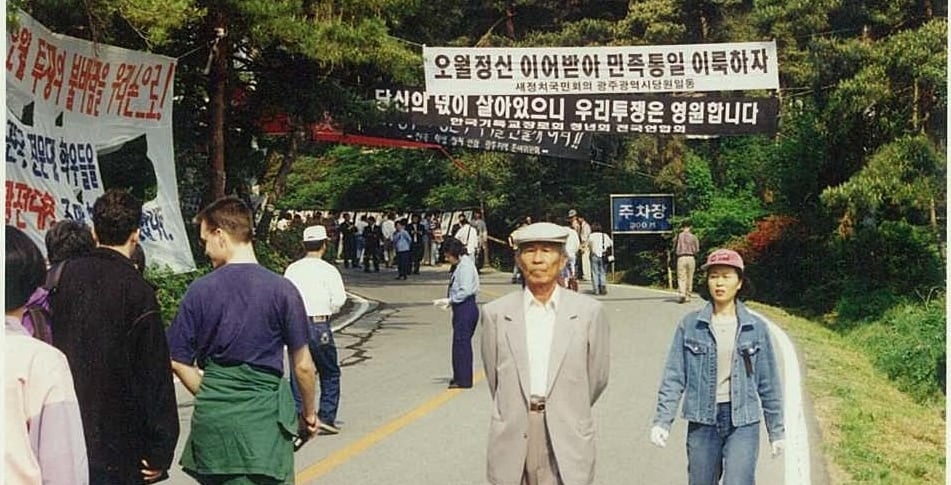
I first remember my visit to Kwangju in May 1996. I was welcomed at the Kwangju Airport by young volunteers from the Kwangju Citizens’ Solidarity (KCS). Together with a group of international activists, I was arriving to participate in the International Youth Camp for Succession of May Uprising Spirit and on Human Rights, Peace and Democracy, organized and hosted by KCS. To my knowledge, this was the first time that a larger group of human rights activists from around the world had gathered in Kwangju. Participants came from 21 countries in Asia, the Pacific, Europe, and Africa, including a professor from Africa who was in exile in Germany. Most of the youth, however, came from Asia. At that time, I was working with the Hong Kong–based Asian Human Rights Commission (AHRC) and represented both the organization and my country, Sri Lanka.
The camp, held from 14-20 May at Songnam Nature Camp in the suburbs of Kwangju, allowed youth from around the world to share their experiences, including ongoing struggles for democracy, rule of law, and human rights, with a larger audience that included Korean civil society organizations. It was a period when Indonesia was still under Suharto’s dictatorship, and activists from the region shared the challenges facing civil society groups struggling to restore democracy. Representatives from Nepal, Cambodia, the Philippines, and East Timor (then under Indonesian occupation), as well as figures linked to the governments-in-exile of Myanmar, Bhutan, and East Timor, participated, highlighting how deeply Gwangju’s experience resonated with democratic struggles across Asia. More importantly, it was the first time many of us gained an in-depth understanding of the Kwangju Uprising. There were presentations by eyewitnesses, as well as videos and other material, which we studied during the Youth Camp. The camp took place at a historic turning point. Through the enactment of special laws, the May Gwangju Uprising was firmly established in Korea’s national memory as a democratic movement, not merely as a suppressed regional tragedy.
After this event, in 1996, I wrote an article entitled, Kwangju: A Flame of Democracy, which was published by AHRC in its publication, Human Rights SOLIDARITY. In the article I wrote the following:
“Kwangju is a city of people’s power and democracy. The people in Kwangju were not even able to talk about the Kwangju Uprising for many years. This year, they were able to publicly commemorate the Uprising with the added impetus given by the present [Kim Yong Sam] government’s move to bring to trial the perpetrators of human rights violations, the two former presidents, Chun Doo-hwan and Roh Tae-woo. However, the story does not end there, even if the two former presidents are going to be [convicted]. There are many wounds to be healed among the people of Kwangju even after 16 years. Ironically, there still has not been a full-scale, in-depth inquiry into the Kwangju Massacre.
“People in Kwangju are able to commemorate the Kwangju Uprising with much hope for the future. The spirit of the people, or the Spirit of Kwangju, was evident among the thousands of people who gathered on the evening of 17 May in the city and on the morning of 18 May at the Mangwol-dong Cemetery, where most of the victims were laid to rest. Today’s situation has improved compared to that of 1980. The people of Kwangju have struggled a long way to achieve their goals and aspirations for democracy. They shed light upon all Asian nations. They bring hope to many people still kept under military regimes with ongoing gross human rights violations, especially in places like Myanmar and East Timor, to continue with their full strength. They bear witness that someday, sooner or later, those perpetrators will have to be accountable to the people whose rights are being violated in brutal forms. They also affirm that there is no escape for those perpetrators of human rights violations, and sooner or later, they will be [brought to justice] and punished.
“The message of peace and democracy was in the blood of the people of Kwangju. It was too costly, for they had to shed that blood. Although physically dead, the spirit of those [lost] lives remains within the people of Kwangju, and the same blood carries on the struggle for peace and democracy [beyond Kwangju, beyond Korea, to Asia and the world].”
When I wrote that article, I shared the same aspiration as many at KCS, people like Soh Eugene, Lee Jai-eui, and Yoon Jang-hyun, to spread the spirit of Kwangju around the world. I joined the small group engaged in that task, alongside figures such as George Katsiaficas. Those modest efforts have since given rise to many subsequent initiatives, some of which I have managed to include in this article. Later on, many sons and daughters, such as Park Jaeman, Kim Sooa, Moon Jeong-hong, Lee Do-kwon and Jin Joo also contributed by working for Asian civil society organizations, carrying old memories with youthful spirit to inspire many others.
KCS itself was a unique formation at that time. Formed in 1994, it organized the first international symposium to recognize the May 18 Uprising as part of the universal struggle for freedom, justice and peace. In 1995, KCS facilitated bringing Argentinian human rights activists to Kwangju. Its members included activists such as Soh Eugene, who had worked for decades in the United States to highlight human rights violations under successive military regimes in Korea during the 1970s and 1980s, and Austine Koh, who came from Texas. There were also local leaders such as Dr. Yoon Jang-hyun, a businessman and eye doctor who was active in organizations like the Kwangju YMCA; Professor Oh Su-sang, who researched the continuing trauma of massacre survivors; Professor Na Kahn-chae, who studied the uprising and massacre; and Kim Young-jib, a civil society activist and aspiring politician. Perhaps most significantly, there was Lee Jai-eui, a journalist in 1996 who had taken part in the uprising, been arrested and tortured, and later authored Kwangju Diary, the first systematic account of the facts of the Uprising and Massacre. In many ways, KCS was truly a citizens’ initiative with a clear objective: to internationalize the spirit of Kwangju. My own journey of doing so began in 1996 and will reach its thirtieth year in 2026.
The 1996 Youth Camp also produced lasting by-products. One participant was Karen Tse, a former U.S. public defender who at the time was training a small number of lawyers who had survived the Khmer Rouge in Cambodia. My friendship with Karen began in Kwangju that May. Later, in 2000, she founded International Bridges to Justice (IBJ), dedicated to preventing torture and abuse in criminal justice systems and to protecting due process and fair trial rights. In 2006, Karen invited me to join IBJ to lead its international programs, and by 2026 my journey with IBJ will also mark twenty years.
In 1997, KCS convened a symposium entitled “Kwangju in the Eyes of the World”, bringing back many international journalists who had reported on the Uprising in 1980. The event generated firsthand accounts from well-known reporters such as the late Terry Anderson of the Associated Press, Norman Thorpe of The Wall Street Journal, Jürgen Hinzpeter of Germany, and Bradley Martin of The Baltimore Sun. Their testimonies were later published as Kwangju in the Eyes of the World, the first compilation of international reporting on the uprising and massacre, at a time when the internet did not exist to spread news globally.
After the Youth Camp in 1996, some participants were hosted by KCS members. I was privileged to stay with Lee Jai-eui, and during our conversations we discussed an ongoing AHRC initiative: the drafting of the Asian Human Rights Charter – A People’s Charter, the first civil society effort to articulate a regional human rights text. The Charter was designed to affirm universal human rights principles in Asia and to counter the “Asian Values” narrative promoted by leaders like Lee Kuan Yew, Mahathir Mohamad, and Suharto, which was often used to justify authoritarian practices. I suggested to Lee Jai-eui that the Charter should be declared in Kwangju. He responded positively, and after extensive discussions between AHRC and KCS, we agreed to host the declaration in May 1998.
Preparations for this conference were nearly derailed by the Asian Financial Crisis of 1997, which severely affected South Korea. Despite economic challenges and difficulties in fundraising, KCS persisted, raising support from many individuals and institutions. In May 1998, KCS successfully hosted the International Conference to Declare the Asian Human Rights Charter – A People’s Charter, from 15–17 May. The event brought together around 200 participants, including more than 60 Asian human rights defenders and jurists. On 17 May, the Charter was officially declared in front of the Provincial Hall before thousands of gathered citizens. The Charter later became a key reference point for civil society, academia, and even governments, for example, Taiwan used it to frame national human rights policies.
It was during this time I also get connected to George Katsiaficas, best known for his theory of the “eros effect”, has written extensively on Gwangju and Korean democracy, devoting roughly a quarter of Asia’s Unknown Uprisings, Vol. 1 to the 1980 Gwangju Uprising and its legacy, and frequently lecturing in Gwangju on the city’s global significance. Lee Jai Eui also would connect me to Tim Shorrock, an investigative journalist, has focused on U.S. accountability: through FOIA he obtained and later donated to Gwangju thousands of declassified U.S. government records (the “Cherokee Files”) on Washington’s role in 1979–80, built a public database of the documents, and has continued reporting on their implications. Together, their work has deepened historical understanding of Gwangju while pressing for truth and responsibility beyond Korea’s borders.
By the late 1990s, other Gwangju-based organizations also began supporting international solidarity. The May 18 Memorial Foundation, under the leadership of Yoon Yang-kyu, and the Association of Bereaved Family Members of the Gwangju Uprising (or Family Association), under Chung Soo-man, invited families of victims of human rights violations to join the May commemoration events. In 1999, the first groups of families of enforced disappearance victims came from Sri Lanka and East Timor. I personally witnessed a profound moment when a Sri Lankan mother, whose son disappeared in 1989, embraced a Gwangju mother who had lost her son in May 1980. Though they could not speak each other’s language, their grief and pain were universal, and they found solidarity in their shared loss.
From these beginnings, Gwangju grew into a regional hub for human rights and democracy. In 1999, the Asian Democracy Victims’ Gwangju Network was launched, followed in the 2000s by the Gwangju International Peace Forum, which broadened participation to include survivors, defenders, and organizations confronting state violence and repression. Among the first participants was Jayanthi Dandeniya, a Sri Lankan woman whose fiancé had been abducted, extrajudicially killed, and disappeared in 1989. Visiting Gwangju in 1999 as part of the first delegation of families of the disappeared, she told me how deeply moved she was by the Family Association in Gwangju and the 5.18 National Memorial Cemetery. Standing before the monumental cenotaph there, she asked me: “When will we be able to build such a monument for the disappeared in Sri Lanka? Will we ever be able to do that?”
Her question inspired further action. I spoke with Basil Fernando of the Asian Human Rights Commission (AHRC) and Eugene Soh of KCS, who in turn discussed the idea with Chung Soo-man of the Gwangju Family Association. Together, they mobilized resources to make this vision a reality. In February 2000, a monument for the disappeared—the first of its kind in Sri Lanka, led by families of victims, activists, and civil society groups—was inaugurated at Raddoluwa Junction. Chung Soo-man traveled from Gwangju to witness the event and stand in solidarity.
Through this initiative, the Gwangju Family Association forged a lasting connection with families of the disappeared in Sri Lanka. The monument became both a landmark symbol in the fight for truth and justice, and a sacred space where families could mourn and honor loved ones who had vanished without a grave to visit.
The year 2000 marked the launch of the Gwangju Prize for Human Rights by the May 18 Memorial Foundation, with the very first award presented to Xanana Gusmão of East Timor, recognizing his leadership in the struggle for independence and human rights. Since then, the Foundation has carried this tradition forward each May, honoring courageous defenders of democracy and human dignity from across Asia and beyond. Many recipients have represented or advocated for victims’ families, ensuring their voices remain central in the struggle for justice. Through the prize and its commemorations, Gwangju’s own history of resistance is linked to contemporary movements, keeping alive the memory of the May 18 Uprising while inspiring solidarity and democratic aspirations worldwide. The 5.18 Foundation also began supporting human rights initiatives in Asian countries in the early 2000s. They convened study sessions that brought Asian activists — especially youth working for human rights — to Kwangju. I remember assisting the Foundation as a trainer in several of these workshops. Kim Chan-ho, who led the Foundation’s International Department, played a pivotal role in accelerating and expanding its initiatives to connect with the world, particularly in supporting human rights activists and organizations from Asia.
Kwangju Citizens’ Solidarity (KCS) gradually transitioned into what is now the Gwangju International Center (GIC). GIC expanded the mission of KCS by keeping alive the spirit of May 1980 through programs and publications, while integrating foreigners living in Gwangju into its human rights and community work.
Originally established as the Kwangju Center for International Visitors, GIC has long worked to bridge local and international communities. It publishes Gwangju News, the city’s first English-language monthly magazine, which shares Gwangju’s democratic legacy with a global audience. The center also organizes cultural and civic programs such as the GIC Citizens’ Choir, public lectures, art events, language exchanges, volunteer programs, and the annual “GIC Week,” bringing residents and foreigners together in dialogue and solidarity.
In recent years, GIC has expanded its role in capacity building for human rights administration, including KOICA-supported training programs for local officials from across Asia. It has also run fellowship programs on inclusive community development, co-hosted the Human Rights Paper Session at the World Human Rights Cities Forum, and strengthened international partnerships through exchanges such as a 2025 visit to Graz, Austria.
Through these initiatives, GIC continues KCS’s foundational purpose, not only memorializing the May 18 Uprising but also making its lessons alive, inclusive, and globally connected. By involving both Korean and international residents as active participants and leaders, GIC ensures that the May 1980 spirit remains a living part of civic life.
[ More text to be added here on events and initiatives by the 518 Foundation ]
In 2007, the Peace Forum was held alongside the East Asia Human Rights Forum, further amplifying victims’ voices. The city’s influence continued with the launch of the Gwangju Asia Forum in 2010, and in 2011 it hosted the first World Human Rights Cities Forum, which adopted the landmark Gwangju Declaration on the Human Rights City. Since then, Gwangju has held annual gatherings with broad participation from families of victims of political violence, enforced disappearances, and extrajudicial killings across Asia.
In 2015, Gwangju hosted the Forum on the Future of Human Rights in Asia, co-organized by the May 18 Memorial Foundation, FORUM-ASIA, and the Asia Democracy Network. Testimonies from victims’ families from Sri Lanka, the Philippines, and Myanmar connected regional struggles in powerful ways. That same year, the May 18 Academy—a two-week training program for human rights and peace activists, was highlighted as another crucial platform. Established in 2004, the Academy continues to provide field trips, workshops, and lectures on Korean democratization, equipping grassroots activists and victims’ representatives with tools for advocacy.
Taken together, these events demonstrate how Gwangju has evolved from a site of national tragedy into a beacon of international cooperation. The city has not only preserved the memory of its own victims but has also empowered families, activists, and civil society across Asia to continue the struggle for democracy and human rights. Thirty years after my first journey there, I see that the spirit of Gwangju remains alive, an enduring flame that continues to inspire Asia and the world.